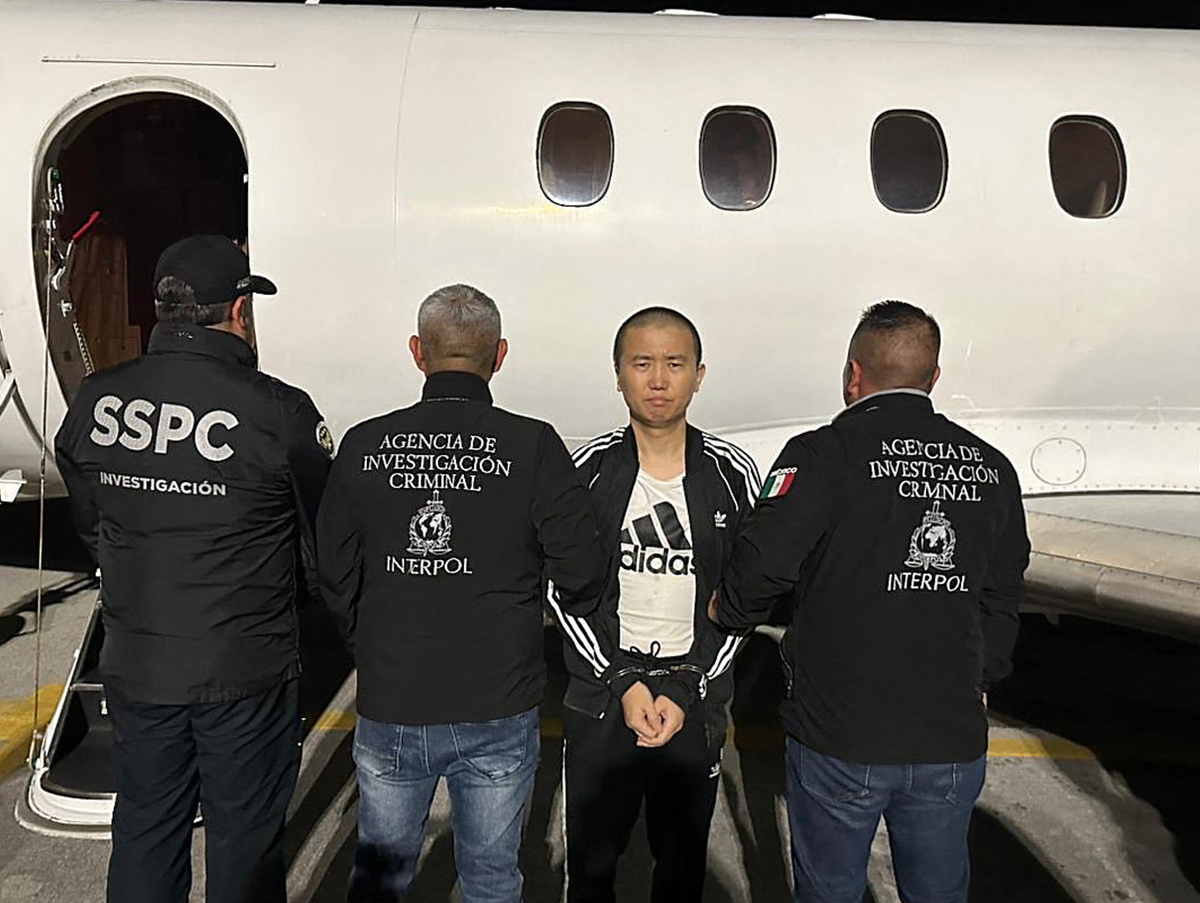
More revealed about ‘Brother Wang’ the alleged Chinese fentanyl supplier for the Sinaloa Cartel
Plus, Panama delegation heads to Beijing to calm canal dispute

Plus, Panama delegation heads to Beijing to calm canal dispute
Subscribe for regular briefings, reports and updates on the China-Latin America relationship.
Never miss a market movement, diplomatic fall-out or security development again.
LATAM–China Monitor
Weekly LCM Briefing | Issue #13 | Coverage: [12-18.07.26]
| Mexico | Brazil | Chile | Panama |
This week — key signals:
- Chinese fentanyl precursor supplier for the Sinaloa Cartel awaits trial
- White House trade advisor, Peter Navarro, has accused Mexico of ‘masking’ Chinese inputs into cars
- Brazil continues its moves to issue Panda Bonds
- Chilean naval docks have been servicing sanctioned Chinese fishing fleets
- A Panamanian delegation is heading to Beijing to calm tensions after the CK Hutchison-canal dispute
Mexico:
Crime
- [SIGNAL] While awaiting trial in New York, more has come out about the alleged Chinese drug kingpin and fentanyl precursor supplier for the powerful Sinaloa Cartel, Zhang Zhidong or ‘Brother Wang.’ Zhang was extradited to the US in 2025, after having previously escaped arrest in Mexico in 2024. Zhang has pleaded not guilty. Named the ‘King of Fentanyl’ by the Sinaloa Cartel, Zhang started life as a Spanish student at the prestigious Peking University, before moving to Mexico in the early 2010s to work for a Chinese mining company. US court filings accuse Zhang of starting to build a massive fentanyl supply chain beginning in 2016. Meanwhile, Mexican authorities have claimed that Zhang exported more than 1,000kg of cocaine, 1,800kg of fentanyl and 600kg of meth and more than US$150mn of annual proceeds. Why this matters: The Trump administration has been vocal about Chinese involvement, and collusion with Mexican cartels, in the fentanyl epidemic in the US. While 100% of fentanyl precursors are monitored by Chinese authorities — there are over 160k chemical companies in the country, and most precursors have industrial uses. Beijing will continue to point to bad actors like Zhang, while Trump continues to insist on structural elements to the crisis. Zhang’s trial may well prove a bully pulpit for the American president. Source: [BBC]. [T4-BW]
Trade
- [SIGNAL] [15.07.26] The Trump administration has long accused Chinese companies of using Mexico as a ‘nearshoring’ backdoor into US markets. Now, as the USMCA is being renegotiated, White House Trade advisor, Peter Navarro, has accused Mexico of ‘masking’ Chinese components in automobiles entering the US. The accusations, published in The Hill, come only a few days before the 20th of July bilateral review meeting between Mexico City and Washington’s representatives. “The more complex the vehicle, the more possibilities there are to hide Chinese components,” Navarro argued in The Hill op-ed. On July the 1st, the Trump administration decided not to automatically renew the USMCA, instead opting for renegotiations, citing the automotive industry as a major concern. Why this matters: Widespread concern about Chinese components in Mexican automobiles within the USMCA might well spur Washington to lobby for much tighter ‘rule of origin’ policies. Source: [Mexico Business News]. [T3-BSP].
- [WATCH] [16.07.26] The Mexican Ministry of Economy has concluded its investigation into Chinese dumping of boxboard into the country, applying rates of $0.2837 to $0.4854 per kilogram, only avoidable when the product is proven to not be Chinese. The tariffs will remain in place for 5 years. Source: [FastMarkets]. [T4-BSP].
Brazil:
Debt
- [SIGNAL] [17.07.26] Brazil has continued its move towards the issuance of Yuan-denominated debt aimed at Chinese buyers, or so-called ‘Panda Bonds.’ The Lula administration’s finance minister, Dario Durigan, who has been leading the effort has suggested that the issuance might reach up to 5bn Yuan (US$740mn), mirroring previous Euro denominated bond issuances Brazil has conducted. It’s been suggested that the capital raised will be earmarked for “sustainable infrastructure, decarbonisation initiatives, and the green transition.” Brazil’s president, Lula, has long been a critic of the US dollar’s ‘exorbitant privilege.’ African nations, who often find that their dollar denominated bonds are affected by the ratio between the strength of the US currency and their own currencies, making repayment incredibly onerous. Now, it seems like Brazil’s Panda Bond issuance might become a model for African states, with fellow Portuguese-speaking state Mozambique watching the Brazil-China deal closely for precedent setting. Why this matters: Trump has previously threatened nations for undermining American currency hegemony through de-dollarisation with tariffs — however, the US’s reliance on Brazilian agricultural inputs will make it hard for any administration to strongly punish Lula. Source: [Bloomberg / Bloomberg]. [T4-BW].
Diplomacy
- [WATCH] [14.07.26] Speaking at a Mercosur summit, President Lula called for the trade bloc and common market association to push for a free trade agreement with Beijing. China already has deep involvement in South American EV and green energy markets. Source: [China Daily]. [T2-BC].
Tech
- [WATCH] [17.07.26] Brazil is joining Cuba and Venezuela in a Chinese-backed AI organisation, the WAICO (World Artificial Intelligence Cooperation Organization). WAICO intends to be an “independent intergovernmental international organisation” based in Shanghai. Source: [BN Americas]. [T4-BSP].
Trade
- [NOISE] [17.07.26] Chinese Foreign Ministry spokesman, Lin Jian, responding to a question about potential tariffs placed on Brazil by the US, reiterated Chinese support for Brazil’s place in a global system of free trade with the WTO at the centre. Source: [Global Times]. [T2-BC].
Agriculture
- [WATCH] [17.07.26] Roberto Perosa, the president of Brazilian Association of Meat Exporting Industries (Abiec), has stated that his organisation expects around 900k tonnes of beef to be exported to China by the end of 2026, down 748k tonnes from 2025, costing the Brazilian industry around US$4.5bn in revenue. The decline is a response to a new quota instituted by Beijing which limits Brazil’s beef imports to China to 1.1mn tonnes. Industry leaders expect production aimed at the Chinese market will restart in Q4 of 2026 — arriving in China by 2027 when the quota resets. Source: [Valor]. [T3-BN].
Argentina:
Infrastructure
- [WATCH] The Argentine government under Milei has started an anti-dumping investigation into Chinese manufactured windfarm towers under Resolution 218/2026. This investigation occurred after producers, mainly GRI Calviño Towers Argentina, started noticing large ratios between Chinese domestic price points and Argentine equivalents. Some have claimed that Chinese prices in Argentina for wind farm towers are between 31 and 38% lower than domestic manufacturers. The investigation will look into damage against domestic players occurring between 2023 and 2026. Source: [Strategic Energy]. [T3-BSP].
Chile:
Military
- [SIGNAL] [15.07.26] The environmental NGO, Circulo de Politicas Ambientales, has published a report accusing the Chilean navy of servicing Chinese fishing fleets accused of illegal, unreported and unregulated (IUU) fishing activities by the US Treasury’s Office of Foreign Assets Control (OFAC) — sparking concerns about conflict of interest. According to the report, various Chinese fishing fleets have sought repair services at the navy’s Astilleros y Maestranzas de la Armada (ASMAR). The Chilean navy is the authority in charge of regulating foreign fishing activities in its waters, prompting questions about the body’s objectivity. The report also noted that Chinese fleet visits increased massively after a visit to China by Gabriel Boric’s defence minister Maya Fernández Allende in September 2024. Why this matters: Chile’s newly elected right-populist President Kast may well use the report to attack his left-wing predecessors, in an attempt to gain currency with Trump. However, Chile’s current bilateral trade relationship with China and reliance on Beijing as a consumer market for its copper and lithium will likely constrain Kast to rhetoric rather than substantive action. Source: [Seafood Source]. [T3-BSP].
Commodities
- [WATCH] [15.07.26] Chile’s state owned copper producer, Codelco, has said its joint venture (JV) with multinational mining company Rio Tinto (14.55% of its London issued stocks are controlled by Chinese SOE Chinalco), to open a lithium mine in the northern salt flat of Maricunga is eight years away from production. This is partly because the JV is waiting on approval from both the Chilean and Chinese governments, after receiving the greenlight from competition authorities in Brazil, South Korea and Poland. Source: [Finimize]. [T2-BSP].
Panama
Shipping
- [SIGNAL] [16.07.26] Panamanian officials are heading to Beijing in an attempt to end a spiralling conflict that has seen Panama flagged ships detained by Chinese authorities, and a consequent outflow of Panama registered ships in response. Beijing started cracking down on Panama-flagged ships in its waters in response to the Central American country taking over the CK Hutchison controlled (under concession) ports of Cristobal and Balboa on the Panama canal. China has claimed that the rapid uptick in detentions is down to ‘safety issues’ rather than a calculated response to CK Hutchison’s expulsion. According to Lloyd’s List Intelligence, Panama-flagged ships have dropped by 537 units in the last four months. Why this matters: Panama has historically been a ‘flag of convenience’ for shipping, allowing owners to bypass constraining regulations in their domestic states. With a steep drop off caused by the Panama canal dispute, President Mulino will be cautious about caving into Trump administration pressure regarding other Chinese investments and concessions on the canal. Source: [FT]. [T4-BW].
Further Reading:
Pew Research, ‘How do views of the US and China Compare in Latin America,’ [15.07.26]
Bloomberg, ‘Peru Tests the Limits of Trump’s Anti-China Stance,’ [10.07.26]
Atlantic Council, ‘Inside the Power Struggle Over Venezuela's Debt Restructuring,’ [10.07.26]
Sl Guardian, ‘China controls 10% of Nicaragua Through Gold Mining Concessions,’ [17.07.26]
Americas Quarterly, ‘The Liberal Order is Unraveling in the Americas,’ [14.07.26]
About this briefing:
LATAM–China Monitor (LCM) aggregates weekly developments in policy, politics, infrastructure, commodities, energy, FDI, diplomacy, and military cooperation across Latin America and China. This project is designed to support future strategic briefings and political risk advisory services from SinoAméricas (SA).
Subscribe for future briefings
This briefing is free and focuses on aggregation.
Want deeper analysis on China-LATAM relations? Contact info@sino-americas.com
Know someone tracking China-LATAM? Forward this briefing.
Analytical weekly briefings, risk reports and corporate advisory services will be available in the medium-term.