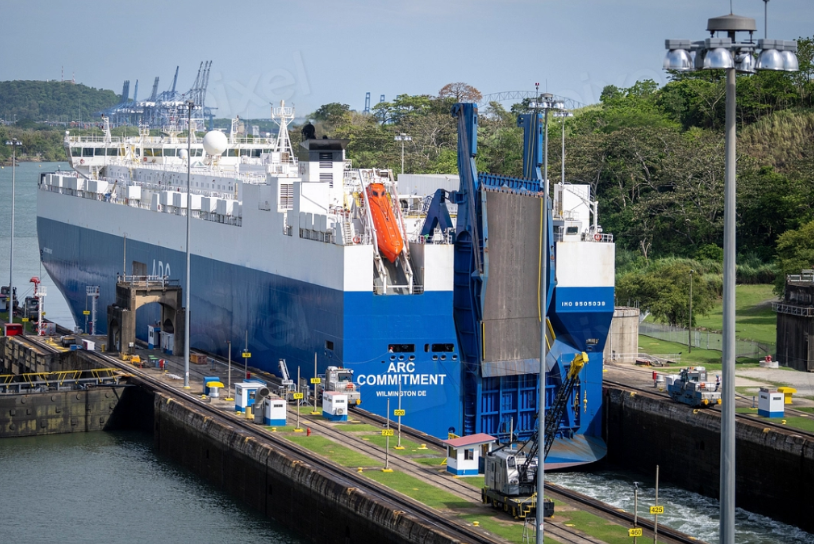
Supreme Court rules against CK Hutchison ports on Panama Canal
Panama's Supreme Court rule against CK Hutchison, China Molybdenum Company Limited (CMOC), has closed the purchase of Equinox Gold’s Brazilian mining facilities for up to US$1bn, Chinese SOE, PetroChina has told its employees not to buy Venezuelan oil, post the US's intervention in Caracas
LATAM–China Monitor
Weekly LCM Briefing | Issue #3 | Coverage: [26.01 — 02.02.26]
Panama | Argentina | Mexico | Bolivia | Peru | Uruguay | Brazil | Venezuela
Key:
SIGNAL — Confirmed action with material or strategic impact.
WATCH — Developments indicating possible future action.
NOISE — Informational updates without material impact.
This week — key signals:
- Panama's Supreme Court rule against CK Hutchison
- China Molybdenum Company Limited (CMOC), has closed the purchase of Equinox Gold’s Brazilian mining facilities for up to US$1bn
- Chinese SOE, PetroChina has told its employees not to buy Venezuelan oil, post the US's intervention in Caracas
- Bolivian minister Marco Calderón has cancelled a zinc mine contract with a Chinese consortium worth US$350mn
The view from Beijing:
- Ministry of Foreign Affairs (MFA) spokesman Guo Jiakun has responded to claims made by the Chairman of the House Select Committee on China, John Moolenaar, during a Panama visit that Chinese presence in the region was “coercive.” Jiakun responded to the accusation in his regular press conference. “China firmly opposes certain U.S. politicians pointing their fingers at the normal exchanges between Central American countries and China.” Jiakun argued that: “China has all along upheld the principle of mutual respect, equality, mutual benefit, openness, inclusiveness, and win-win cooperation and delivered tangibly for the local people.”
- In a subsequent press conference, Jiakun reiterated China’s commitment to Cuba. Havana is currently dealing with dwindling reserves of oil, as access to Venezuelan imports have been blocked off by US naval blockades. “China is deeply concerned by and strongly condemns the U.S.’s moves and urges the U.S. to stop depriving the Cuban people of their rights to subsistence and development,” says Jiakun. The MFA spokesman went on to say: “China will continue to do what it can to provide support and assistance to Cuba.” However, at the time of writing, Beijing has not moved to either sell Cuba a percentage of its oil reserves or donate energy as aid.
- While Venezuela oil exports have never made up a large proportion of China’s energy imports, they may become a conflict flashpoint if they start flowing towards the US and its allies, and away from Chinese partners in the region. Now, the US Export-Import Bank is actively supporting IOCs (International Oil Companies) investment into Venezuela. Large multinational IOCs will very likely abide by US sanction regimes and choke off Venezuelan oil flows to Havana. In the medium-term, Cuba’s loss of oil presents an opportunity for Beijing to either cut its losses with a struggling security partner, or leverage Havana’s reliance on aid and energy imports into a more clientelistic relationship.
- The new Asian Infrastructure Investment Bank (AIIB) president, Zou Jiayi, has reemphasized the importance of “multilateralism” at the 2026 Asian Financial Forum, citing “rising global economic uncertainty.” The AIIB is a multilateral institution with 111 members and active investments in LATAM. However, Jiayi has been seen, in some quarters, as too close to the CCP, having previously served in the finance ministry of the PRC.
- Spanish energy and infrastructure corporation Acciona signs a EUR 206mn financing deal with Chinese SOE Sinosure (China’s Export Credit Agency). The deal is aimed at sustainable energy project purchasing from third parties, with Sinosure insuring and lending credit lines for procurement. The Spanish company’s energy arm, Acciona Energía, has invested in several LATAM projects: including the 246 MWp peak, El Romero Solar farm in Chile’s Atacama Desert and the Dominican Republic’s Cotoperí Solar (162.6MWp). A large proportion of these “third party” suppliers will probably be Chinese, with Sinosure presumably underwriting the risk of non-payment from Acciona.
- Chinese development financing through the China Development Bank (CDB) and Export-Import Bank (Exim) aimed at the LATAM region has continued a slow decline, according to data from Boston University’s Global Development Policy Center. While there was a small uptick in financing from these two institutions in 2024, to $2.8 billion, a four year high, the total remains well below the $25 billion spent in 2010 by the CDB and Exim in Latin America. Indeed, the World Bank and Inter-American Development bank both overtook China in 2018 and 2016 respectively. In contrast, Beijing has pivoted away from bilateral financing, and towards direct FDI and policy moves that increase aggregate two way trade with LATAM nations.
Brazil:
Policy
- Watch [26.01.26] Brazil and China have announced a bilateral agreement to remove short-stay visa restrictions on each other's citizens. President Lula announced Brazil will grant exemptions “from some” short-stay visas for Chinese citizens in response to China’s move to remove visas for Brazilian nationals. Source: [BRI].
Commodities
- Signal [27.01.26] The publicly listed Chinese company, China Molybdenum Company Limited (CMOC), has closed the purchase of Equinox Gold’s Brazilian mining facilities for up to US$1bn. CMOC now controls Brazilian mines in Aurizona (Maranhao state), the RDM in Minas Gerais, and the Bahia Complex mines in Bahia. Source: [Mining].
- Watch [30.01.26] Chinese SOE, China Nonferrous Metal Mining Company (CNMC) has announced it will invest US$100mn in its Brazilian mining operations by 2028. CNMC plans to invest the money through its subsidiary Mineração Taboca (MT). MT operates tin and industrial metal mines in Brazil as well as metallurgy facilities. Its major extractive facilities are located in Pitinga in the western state of Amazonas. Source: [BNAmericas].
- Watch [29.01.26] Sources close to the SOE Aluminium Corporation of China (Chinalco), have reported that it is close to closing a deal with British-Australian mining multinational Rio Tinto to collaboratively purchase control of Brazilian aluminium producer Companhia Brasileira de Aluminio (CBA). CBA’s shares have almost doubled in the last 12 months, according to London Stock Exchange data. Source: [Reuters].
Energy
- Watch [30.01.26] SOE China Three Gorges Corporation;s (CTG) subsidiary CTG Brasil has launched a laboratory in São Paulo state in collaboration with the SENAI Institute for Innovation. The laboratory, located at the Ilha Solteira Hydroelectric Power Plant is intended to study the behaviour of battery energy storage systems connected to solar farms. Source: [CanalSolar].
Agriculture
- Watch [28.01.26] Brazilian soybean exports to China are currently undercutting US equivalents in H1 of 2026. A combination of increased supply and low Chinese tariffs (Brazil’s 3% vs US’s 13%) have led to the South American nation outcompeting the US in exports to China in 2025 and into 2026. Chinese SOEs have continued to purchase US soybean exports, mostly to maintain political capital with Washington. However, private Chinese purchasers have almost all opted for Brazilian alternatives, due to competitive pricing. Source: [Reuters].
Argentina:
Judicial Review
- Watch [30.01.26] Argentina’s Supreme Court has received a civil case between two e-commerce giants: Argentine Mercado Libre and Chinese Temu. The case has moved up to the supreme court after two lower courts refused to issue rulings on the dispute. The conflict originates in Mercado Libre official complaint against Temu for “unfair competition,” including large discount and gamified gambling features. Temu has claimed the filing is "harassment" from a market-dominant competitor. Source: [ChinaLasAmericas].
Mexico:
Diplomacy
- Noise [26.01.26] Chinese ambassador to Mexico, Chen Daojiang, has published an op-ed in Mexico’s El Universal newspaper. The article sets China and Daojiang against “unilateral bullying,” after the US’s extraction operation in Caracas against Nicolás Maduro, claiming Beijing represents: “genuine multilateralism.” Source: [Chinese Embassy — Mexico].
Peru:
Politics
- Watch [28.01.26] Peru’s sitting president, Jose Jeri, has been caught up in an emerging scandal involving undisclosed business relations with a Chinese importer Zhihua Yang. The case has been named ‘Chifagate’ by the Peruvian press and has led to opposition parties issuing impeachment proceedings against Jeri. State public prosecutors have also launched an official investigation into Jeri’s relations with Yang. The president's approval rating has taken a 10% hit since the scandal involving Yang was broken by the press. Source: [Reuters].
Diplomacy
- Watch [30.01.26] Silk Road Ark, the hospital ship currently visiting Latin American nations, was supposed to continue its journey and dock in Peru in February. However, the country’s congress has withdrawn a bill allowing the ship access to Peruvian waters, citing concern about climate and epidemiological crisis and national health resources. It is unclear how the presence of Silk Road Ark would put Peruvian healthcare delivery capacity under strain. The withdrawal comes days after a scandal broke involving Peruvian president Jose Jeri and a Chinese businessman. Source: [ChinaLasAmericas].
Venezuela:
Energy
- Signal [27.01.26] Chinese SOE, PetroChina has told its employees not to buy Venezuelan oil post the US takeover of the Latin American nation’s exports. PetroChina is a large investor in Venezuelan oil capacity, with interests in a joint venture with state-owned Petróleos de Venezuela (PDVSA). This move will have a larger impact on Venezuela than China, which uses oil to pay for outstanding debts to Beijing. Source: [Reuters].
Bolivia:
Commodities
- Signal [28.01.26] Bolivia’s new centre-right mining minister Marco Calderón has cancelled a zinc mine contract in the western city of Oruro with a Chinese consortium made up of China Enfi Engineering Corporation and China Railway International Group for $350 million — citing “overpricing” in the tendering of the agreement. Calderón has also decided to complain about "deficiencies in contract compliance” at the Mutún steel facility, which was handed over to the Bolivians in 2025, after financed construction from China’s Exim bank. The new Bolivian government had previously announced in January 2026, that it would respect preexisting Chinese contracts. Source: [Mining].
Politics
- Watch [30.01.26] Bolivian police have raided offices of Chinese SOE Sinohydro in La Paz, following allegations of financial irregularities in a US$400 million highway project between Cochabamba and Santa Cruz. Sinohydro had been contracted to build the double-lane intersection between the two cities. Source: [Opinion].
Panama:
Infrastructure:
- Signal [30.01.26] Panama’s Supreme Court has announced its decision to remove Hong-Kong based shipping and port company CK Hutchison from Panama Canal ports. The court communicated on the 29 of January that it had found port concession laws reaching back to 1997 “unconstitutional,” and that the agreement between Panamanian state and Panama Ports Company S.A (a majority-owned subsidiary of CK Hutchison) is void — effecting Chinese operations in the canal ports of Balboa and Cristobal. Panama’s president, Mulino, has declared that Danish shipping firm AP Møller-Maersk will run the ports on a preliminary basis. CK Hutchison had previously had its lease extended on the ports, without competition, in 2021. Source: [Panama Supreme Court / Financial Times].
Uruguay:
Diplomacy
- Watch [30.01.26] President Yamandú Orsi, of the centre-left Broad Front coalition, has departed for China at the head of a 150-person delegation. Orsi is due to meet with Xi Jinping on 3 February 26 — to discuss commercial, academic and diplomatic relations with the South American nation’s largest trade partner. Uruguay’s main exports to its dominant trade partner include wood-pulp, soybeans and beef. [MercoPress].
Further reading:
The Diplomat, ‘A Decade of Questionable Governance at the Asian Infrastructure Investment Bank,’ [27.01.26] — an op-ed criticises the AIIB’s closeness to Beijing and record on human rights.
The Economist, ‘China’s Rare Earth Chokehold Terrifies the West, but Brazil Benefits,’ [29.01.26] — Brazil under Lula tests out an industrial policy on rare earth metals; China and the US watch closely.
Small Wars Journal, ‘The Impact of Chinese Organised Crime in Latin America,’ [01.02.26] — It's not just cartels in LATAM that governments have to worry about. SWJ claims that extended Chinese organised crime networks are taking advantage of relative security-state weaknesses in the region: accessing fishing and mining operations.
About this briefing:
LATAM–China Monitor (LCM) aggregates weekly developments in policy, politics, infrastructure, commodities, energy, FDI, diplomacy, and military cooperation across Latin America and China. This project is designed to support future strategic briefings and political risk advisory services from SinoAméricas (SA).
Subscribe for future briefings
This briefing is free and focuses on aggregation.
Want deeper analysis on China-LATAM relations? Contact info@sino-americas.com
Know someone tracking China-LATAM? Forward this briefing.
Analytical weekly briefings, risk reports and corporate advisory services will be available in the medium-term.